Wireless vs Wired Dashcams: Which One Should You Choose?
When it comes to wireless vs wired dashcams, the one you should choose totally depends on what you expect from your camera safety solution. If you want something straightforward that’s without too many bells and whistles, a wireless option might work. But if you’re looking for higher quality and telematics features, then the wired choice is definitely it.
Wireless dashcam setups are still dominating the global market, making up a whopping 60% of global sales. Many everyday motorists are continuing to be attracted to the easy, DIY, and quick configurations, although some are becoming attuned to more durable, premium options.
On the other hand, hardwired cameras for fleet systems are flourishing at a 10.7% annual growth rate. Fleet managers have long ditched the wireless options and recognise the safety of high-end, insight-driven hardwired choices.
Let Cartrack Eswatini make the decision easy for you. Keep reading to find out more about each camera category and what we have available!
Which is the best option: a wireless or a wired dashcam?
Generally speaking, whether a wireless or wired dashcam is better actually depends on what you’re looking for and the role your dashcam will play. But it’s also widely known that wired dashcams are the better choice. They offer far more features and benefits, like high-quality recordings, better battery life, and telematics capabilities.
Let’s look more at each dashcam category:
What are wired and wireless dashcams?
Wired and wireless dashcams are dashcams that have the same core function—mounted in-car recording devices—but are connected differently. As their categories suggest, one is hardwired to the car battery, and the other is connected a bit differently.
But no dashcam is 100% wireless in its connection.
Wired devices are typically connected to the vehicle’s battery, giving them uninterrupted power. On the other hand, it’s rare that wireless devices have no cord at all; they’re usually connected via the 12V (cigarette lighter) socket. ‘Wireless’ is more in reference to how the video data is transferred, like using Wi-Fi or Bluetooth.
Some wireless hardware designs, especially if battery-powered, will allow you to use them without the wires connected, although they’ll only last for a few hours before needing to be recharged.
What does installation look like?
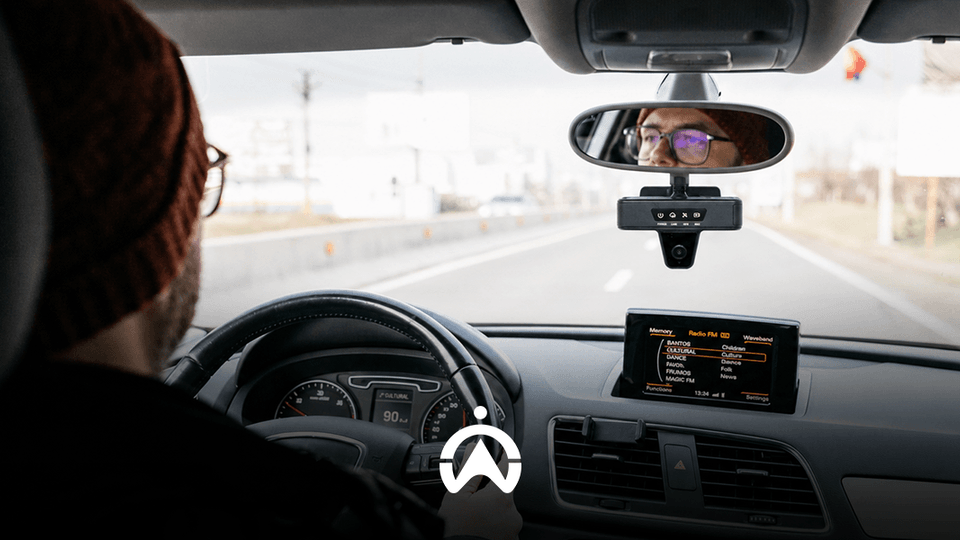
- 🔌 Wired dashcams are usually (and should preferably be) installed professionally. The dashcam will be mounted according to the best non-obstructive position(s) and connected directly to the vehicle’s electrical system or fuse box. The wires and cables are carefully tucked behind the windscreen frame and other structural seals.
- 🛜 Wireless dashcams are typically mounted according to the best non-obstructive position(s) and are suctioned or clipped in place. The dashcam is either connected to the car’s 12V socket or runs on a battery. Most wireless cams need an accompanying app, so you’ll need to download that. Pair the devices and begin recording.
How do each of their systems work?
- 🔌 Wired dashcams are powered by the vehicle itself. They’re incredibly strong in their design, usually maintaining integrity during harsh weather conditions and collisions. Recordings are saved on SD cards and looped when necessary, with some designs accommodating bystander or parking mode. Wired cams typically integrate elements like telematics and GPS tracking too.
- 🛜 Wireless dashcams are powered by a 12V socket. It connects via Wi-Fi or Bluetooth, which then communicates with your phone (and the connecting app). You can manually view and download footage via the app.

Is wired more reliable than wireless?
Yes, wired is typically more reliable than wireless.
There’s an uninterrupted source of power and, without the need for rechargeable energy, there’s far less risk of a fire hazard occurring (due to swelling batteries, etc.). Wired cams are usually cellular-network-equipped, meaning they don’t have to connect to Wi-Fi or Bluetooth, or potentially face signal interference.
Some wired cams also support bystander or parking mode, adding to the security and safety levels. Yes, it’s likely that it’ll cost more than a wireless cam, but the pros heavily outweigh the cons.
If you’re looking for absolute security, long-term reliability, full telematics, and a clean, professional finish to your installation, a wired option is your best bet.
What are the real-world advantages of each dashcam category?
PICTURE THIS:
You’re managing a fleet where you need to equip 60 delivery vans with dashcams before the holiday rush. At first, you strongly consider the wireless dashcams for their easy installation and flexibility. But considering the long-distance routes, you recognise that a consistent power source is non-negotiable.
If footage is lost during an incident or accident, this could mean serious financial and legal headaches for all involved.
Realising this, you decide you’d rather go for the wired dashcams and use them in your dedicated fleet, while reserving the wireless ones for contractors or rentals.
This combo offers the flexibility you’re looking for without sacrificing reliability when it counts.
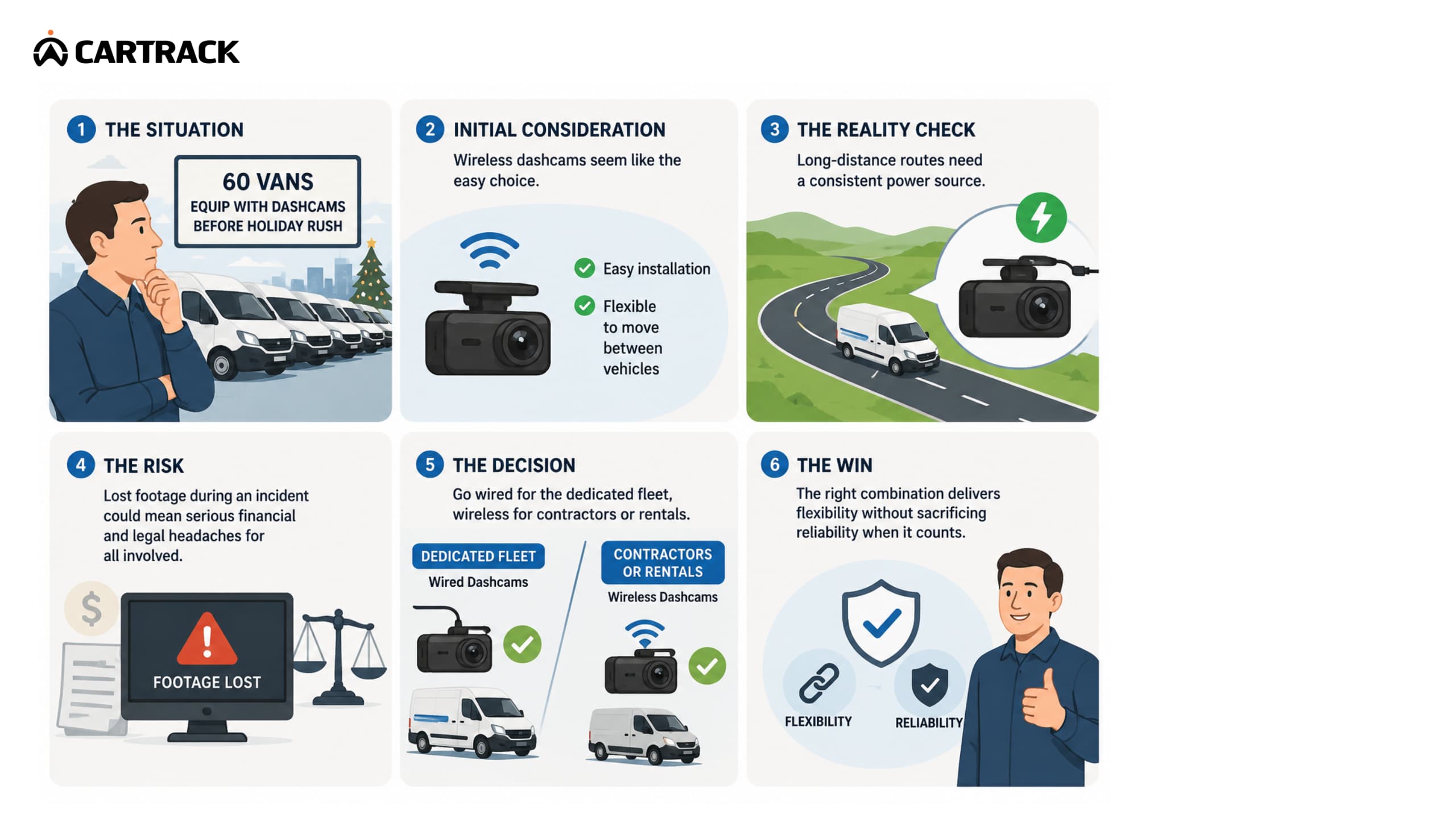
As you can see, both of these options play a pivotal role depending on the context of your need. While wireless is all about flexibility and ease, wired is strong and massively dependable for businesses.
So what exactly are the benefits of each?
- Wired:
- Continuous power source (potentially with parking mode to record while your car is parked or the ignition is off)
- The ability to record various angles through one setup (multi-camera systems)
- Improvement in driver performance and safety through keeping drivers accountable. Dashcam footage can also be used to coach drivers if they’re reoffending
- Maximised durability, which ensures that strong video quality is consistently present
- Night vision/infrared capabilities, which are especially important for night-shift long-haul drivers and e-hailing fleets
- High-quality resolution
- Wireless:
- Installation is simple and DIY-friendly
- Flexibility & portability are the ideal features—especially if dealing with a rented vehicle or using one device between many family members
- Clean, clutter-free finish (which links back to simple installation)
Both provide defence against incidents and potential false claims. These dashcams also have the potential to reduce insurance premiums, as many insurers favour everyday drivers and fleet companies who go the extra mile to protect themselves and their vehicles.
What dashcam and camera solutions does Cartrack offer you?
The dashcam and camera solutions that Cartrack offers you are five core solutions: Road Vision, Dual Vision, Multi Vision, AI Dash Pro, and AI Multi Vision. Whether you’ve got a complex fleet or you just want to protect your beloved car, we’ve got the perfect solution for you.
We don’t offer wireless cameras, and all our core options are hardwired, guaranteeing far better quality and additional features to keep you, your family, or your fleet completely protected.
Here’s a breakdown on what YOU can expect:
Road Vision
Road vision is a single, road-facing camera. Our everyday drivers and small businesses love this option because it’s a simple solution to safety needs, providing accident evidence and helping consumers handle insurance claims more quickly.
This device offers:
- Telematics features
- 128 GB of storage (approximately 72 hours)
- Live streaming & recording capabilities
Dual Vision
Dual Vision is a dual-camera system that’s both road-facing and cabin-facing. This is another winning solution for small businesses and the everyday driver. It works well for accident and insurance claims, adds an extra layer of security, and encourages drivers to behave safely & responsibly on the road.
The in-cabin monitoring keeps drivers on their toes!
Dual offers:
- Telematics features
- 256 GB of storage (approximately 194 hours)
- Live streaming & recording capabilities
Multi Vision
Multi Vision has up to 4 cameras: road, cabin, internal, and external-facing. This solution is an entry into the big leagues, catering to larger-scale businesses like logistics and delivery. Larger fleets tend to require more visibility, especially when cargo is involved.
There’s greater operational oversight in addition to stronger security, and you and your drivers can keep an eye on the blind spots.
Multi Vision offers:
- Telematics features
- Various hardware options for you to choose from (i.e., external side and rear cameras, dashcam dual cameras, dashmount road-facing cameras, etc.)
- 256 GB of storage (approximately 194 hours)
- Live streaming & recording capabilities

AI Dash Pro
AI Dash Pro is a dual-camera system that’s both road-facing and cabin-facing. It has an additional 2 camera channels and the option to add an extra camera to places like your fuel tank, cargo area, etc.
Most importantly, it has AI capabilities that help monitor driver behaviour and record events, such as fatigue, distraction, and smoking.
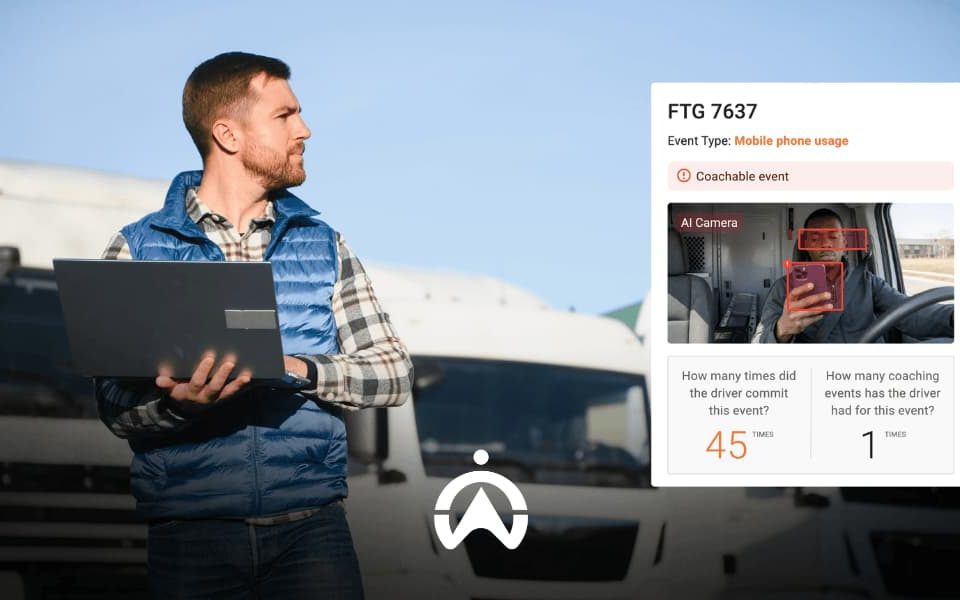
This is the perfect solution for businesses that have large, complex fleets that prioritise total visibility and safety. The AI event recording also makes it far easier for you to monitor your drivers, allowing you to implement driver coaching when necessary and prevent costly downtime.
The AI Dash Pro offers:
- Telematics features
- 512 GB of storage (approximately 100 hours)
- In-cabin calling
- AI capabilities to track disruptive driving events
- Infrared for the cabin-facing camera
- Live streaming & recording capabilities
🆕 NEW ADD-ON to consider:
A small AI monitor for drivers can be included, so they’re visually alerted to the triggered event (sometimes, event audio alerts are missed). Here, the cargo door sensor can also be linked.
AI Multi Vision
AI Multi Vision has up to 8 cameras that are road-, cabin-, internal-, and external-facing. This is the ideal solution for large, complex fleets that are carrying high-risk cargo. Basically, if you’re looking for airtight security, complete visibility, and stronger compliance, this is the option for you.
AI Multi Vision offers:
- Telematics features
- Numerous hardware options (i.e., external side and rear cameras, dashcam dual cameras, dashmount road-facing cameras, etc.)
- 1TB (approximately 291 hours) of storage
- AI capabilities to track disruptive driving events
- High-quality live streaming & recording capabilities
🆕 NEW ADD-ON to consider:
The small AI monitor, as previously mentioned under AI Dash Pro.
Final takeaway: Blind spots are bad for business!
Simple and easy might seem like the most attractive choice, but going the extra mile can truly seal in your vehicle security. Do you want the ease of wireless cams that show you the action, but overlook the bigger picture? Or are you looking for effortless, uninterrupted, advanced, and airtight protection that wired cams can bring you?
This is where Cartrack steps in.
Partner with us to ensure you’re always connected and always protected. With us, and the help of our sophisticated camera solutions, you know you can always account for the truth.
Ditch the messy wires. Forget the dead batteries. Just focus on the real protection. Call us today and get a complete, professionally installed camera solution!
FAQs
Does your insurance go down if you have a dashcam?
Yes, your insurance can go down if you have a dashcam, but it’s not always guaranteed. Insurers are typically in favour of drivers with dashcams because it means they’ve taken the extra step to protect their vehicle (and themselves). This also potentially makes the claims process much easier, thanks to the readily available evidence.
Do you really need a 4K dashcam?
No, you don’t really need a 4K dashcam for basic security, although higher video quality is generally recommended. When you have clearer streaming and recording, your dashcam is likely to pick up on more important details in an incident, like a driver’s number plate or something that occurs in low light. Overall, better detail means greater protection.
How long does 128 GB take to eat up for a dashcam?
It ultimately depends on the dashcam quality, so it can take anywhere between 10 and 24 hours. The 10-hour recording time is what’s typical of a 2K or 1440p resolution recording. Ultimately, the higher the camera quality, the less recording space you’ll have on the SD card.
Should I unplug my dashcam at night?
No, it’s not really necessary for you to unplug your dashcam at night. But you might want to consider unplugging it if:
- You’re not really driving your car for a while, and it’s stationary in an enclosed environment
- You feel that having a visible dashboard attracts criminals more than it deters them
- You’re trying to preserve your car battery