Why Diesel is More Expensive than Petrol and What to Do as a Truck Owner
Motorists across Eswatini experienced shocking petrol price increases in April 2026, but those with diesel trucks and vehicles REALLY felt the pinch. This makes us all wonder why diesel is so much pricier than petrol—and fleet operators are asking this question more than ever!
There are several economic, socio-economic and global reasons. Statista describes diesel demand as “pre-epidemic”, referring to the massive 28.3 million bbl/d (barrels per day) demand in 2024 ALONE. With escalating global tensions, this number just keeps going up.
Diesel demand. Taxation. Global unrest. All of these play a part in why diesel prices have soared. But fortunately Cartrack has some long-term fuel saving solutions that’ll appeal to truck owners across various industries. Here’s everything you need to know.
What are the main reasons for diesel being more expensive than petrol?
The main reasons for diesel being more expensive than petrol are high demand contrasted with low supply, diesel production time & costs, taxation, and global tensions. Another reason is the green practices that are now employed to produce diesel, which are more costly and time-consuming.
Global tensions
Not only are global tensions causing diesel prices to skyrocket, but this military activity also causes market panic. Together, these two factors ALONE do enough to raise diesel prices, making it harder for your trucking business to operate.
High demand for diesel
Eswatini isn’t the only country that relies on diesel to power logistics. Other countries are ordering massive amounts just like we are (high demand), and this is causing the supply to gradually run dry.
In short, countries are ordering diesel at a faster rate than the rate at which it can be produced.
“Clean” diesel production
Governments are clamping down on big industries to lower their carbon footprint, and diesel production plants are NOT exempt from these regulations. It’s more expensive to strip sulphur out of the end product of what’s considered “cleaner diesel”, and these costs are being passed on to the consumer.
Economic factors
There are dozens of economic reasons for diesel being more expensive than petrol, and these reasons combine to create prices that fluctuate constantly. Most of these factors are international and heavily tied to global refining and transport costs, but they still directly hit home because Eswatini imports all of its fuel in massive quantities.
Because the Kingdom depends entirely on importing refined petroleum products, local pump prices are highly vulnerable to international supply chain shifts, crude oil pricing, and global demand. When global refining costs rise, Eswatini fleet operators feel the impact almost immediately.
A quick note on diesel taxation: While diesel taxes are heavily penalised in some countries, the opposite is true in Eswatini. The government structures domestic fuel levies and taxes to favour diesel over petrol. This lower tax rate is a deliberate policy designed to support industrial logistics, agricultural production, and public transport networks—helping to keep the nation’s core economic drivers moving efficiently.
However, there are a number of levies added to diesel and petrol costs, which include:
- A government levy on each litre that’s used to support government spending.
- Sincephetelo Motor Vehicle Accidents Fund (SMVAF) levy that’s used to pay out people who claim for medical care and rehabilitate victims involved in road accidents.
- Road Authority Levy: This levy is used by the Roads Authority to maintain and repair the roads of Eswatini exclusively.
- ERS tax on customs & excise for imported fuel.
- A carbon levy on the emissions of the fuel purchased and consumed.
These extras are all passed on to the consumer, and truck owners who use a lot of diesel for their daily operations are having to spend more on refuelling their vehicles like never before.

What are long-term effects of high diesel prices?
The long-term effects of high diesel prices hit truck owners harder than the average motorist, and these ultimately lead to higher overheads. Whatever business you’re in, higher truck transport costs could also cause you to struggle against your competitors. To stay relevant in your industry, you might even be tempted to cut costs in other areas of your business.
Lower profit margins
The most obvious long-term effect is less profit. Over time, this can cripple a business, because let’s face it: fuel isn’t the ONLY thing getting more expensive. Less profit = lower chance of survival. If your business is making less profit, everybody suffers; you, your staff, and your customers.
Competitive irrelevancy
You might be looking at your competitors and wondering how THEY’RE dealing with the increase in diesel prices.
- Are they transitioning to EV trucks?
- Are they taking advantage of fuel hedging?
- Are they receiving subsidies?
- Or are they just better at marketing?
These are some possibilities, but it’s more likely they’re struggling as much as you are. Or are they?
The fact is, if your competing truck companies are thriving amidst the current fuel crisis, it’s likely that they’ve found a way to reduce fuel use through technology.
The question is, will your truck business do the same to stay relevant?
Cutbacks on essentials
The temptation might arise to cut back OTHER essential operations within your company to subsidise higher diesel costs for your truck company. This could be in the form of staff layoffs, less money towards safety, or opting for a lower marketing budget.
This isn’t always necessary just because fuel prices have gone up. The solution is BETTER fuel management—not cutbacks.
What diesel-saving methods are ineffective?
There’s no magic pill that’ll fix the amount of diesel your truck uses. Saving diesel takes effort combined with technology. Unfortunately, there are a number of fuel-saving gimmicks that dupe truck owners into thinking they’re making a difference. This simply isn’t true.
Here are some you may have heard of already.
Additives to your fuel tank
There are companies out there duping people into buying additives for their fuel tanks, promising that these increase efficiency. Most of these fuel additive promises are scams!
Avoid them at all costs, and also avoid home remedy solutions that promise better fuel consumption if you add home kitchen items to your fuel tank.
Magnetic fuel savers
The claim is that magnetic fuel savers realign the molecules within fuel, causing it to burn at a more efficient rate. There’s no research to back up this claim, so it’s considered an old wives’ tale in the fleet industry.
Filling up at certain times of the day
Is diesel more dense when the weather is cooler? Yes, it is. This makes some people think that filling up early in the morning increases efficiency. But the difference in density is so marginal that it doesn’t make enough of a difference to really affect your fuel usage.
Here’s why.
By the time the diesel comes out of the nozzle to be burnt by your engine, it’s virtually the same temperature as it would be when the weather is warm. Also, any savings you might get from this method will be too small to make any meaningful difference.
Filling strategies
You’ve probably heard rumours that filling your tank to the brim causes your fuel to burn quicker. The truth is, the amount of fuel in your tank has no direct impact on how efficiently your truck engine burns it. Yes, filling your tank to the brim does add some weight to your vehicle, but the difference is negligible.
So what does work?
What should truck owners do to save on diesel costs?
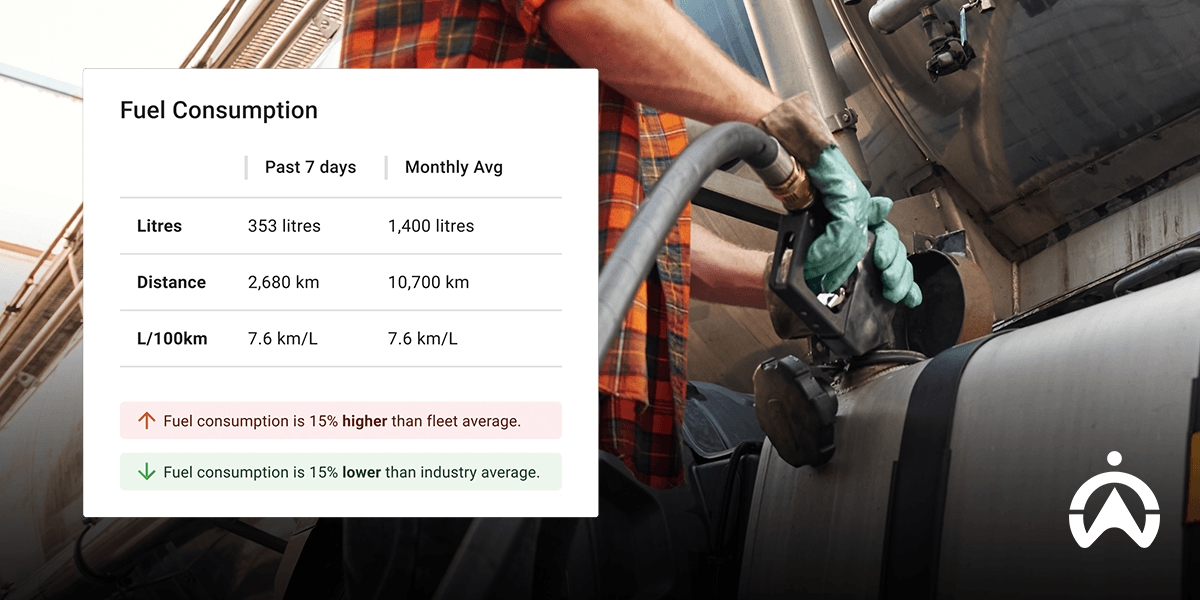
When we strip away the false information about saving fuel, we’re left with what actually DOES work. This isn’t just a claim; it’s fact-based knowledge & industry experience from a fuel management software provider that works closely with truck owners to make a difference in their fuel costs.
Here’s what we’ve learnt over the past two decades.
Calibrate your trucks’ fuel tanks
Saving fuel begins by starting from an accurate baseline. This can only be done through fuel calibration, which involves emptying your truck’s fuel tank and filling any fuel tank (which come in various shapes) with precise increments of fuel.
Your daily operations then generate raw data, and the calibration you get translates that data by giving you accurate litres.
Choose a fuel-monitoring technology that’s truck-specific
Cartrack has a few fuel-monitoring options to choose from, but none are MORE ACCURATE than our fuel probe. A fuel probe works by combining a float IoT device with our gold-standard software.
Once you have this data, our software further refines the information to give you actionable fuel-saving strategies that are specifically tailored to the unique factors of your truck fleet.
This is also the best strategy for stopping fuel syphoning, fuel card fraud, and other bulk fuel anomalies.
Eliminate guesswork and rely on accurate data
The point of our software is to provide you with indisputable metrics that deliver true, relevant, and real-time data. This removes the guesswork out of your fleet operations and puts you in control of saving fuel.
All these small changes add up to lower overheads, helping you to preserve your profits and STAY COMPETITIVE.
Keep your vehicles in top condition
You already know that high-quality data gives you ACTIONABLE STRATEGIES. But what are these strategies?
One is keeping your vehicles well maintained. It’s no secret that well-maintained vehicles burn less fuel, but HOW can you manage this better than what you’ve already been doing?
The answer is predictive maintenance with the help of AI.
This is a strategy that removes the humdrum service schedules you used to do, and alerts you to maintenance needs based on real-time vehicle diagnostics. In addition to this ground-breaking technology, our system even books your vehicles in for maintenance automatically!
Plan and optimise truck driver routes
The less time your trucks are on the road for each delivery, the more fuel you’ll save. The objective of route optimisation is to accelerate your service and make your trucks more productive.
Bypass those pesky roadblocks, heavy traffic congestion, and pothole-ridden roads by using real-time route optimisation that’s flexible, dynamic, and accurate.
Monitor idling and coach drivers
Idling accounts for a bulk of the fuel your trucks waste each day. So does reckless driving! Getting rid of this alone will lower your fuel costs without disrupting your productivity.
Cartrack offers various ways of doing this:
- An alert system that lets you know when excessive idling is taking place
- A driver coaching platform that educates them on idling less frequently
- Sensors that alert you to fuel-guzzling driving habits like speeding or aggressive cornering
- Power-Take-Off (PTO) monitors that give you stop/start data on your trucks
Call us to learn more! Cartrack is dedicated to saving Eswatini truck owners on their diesel costs, but it all starts with your willingness to start the process.
These methods really DO make a difference, so ditch those outdated gimmicks and go digital with a system that works hard to generate savings on your fuel budget.
FAQs
How is diesel different to petrol?
Diesel is basically denser than petrol. Its core make-up has more viscosity, which plays an important part in its slower burning process and high torque offering. Diesel has a distinctly different smell too, making it easy to distinguish from petrol.
Which uses more oil to produce: petrol or diesel?
Petrol takes more oil to produce, but not much. Because of the production process, manufacturers are likely to get more diesel than petrol out of a comparative amount of oil. This refining process happens simultaneously, so both products are derived from the same barrel of oil.